
Netilat Yadayim: Why Jews Wash Their Hands First Thing in the Morning
Netilat Yadayim: Why Jews Wash Their Hands First Thing in the Morning
Let's talk a bit about the laws of netilat yadayim — the morning washing of hands.
Every morning we wake up, open our eyes, and start a new day. But for a Jew, there's one thing worth doing almost immediately after waking — netilat yadayim.
Why does this matter so much? Why isn't it enough to just go and rinse your hands under the tap?
What is ruach ra'ah?
While a Jew sleeps, something called ruach ra'ah — a certain spiritual impurity — settles on their hands by morning.
Simply rinsing with water isn't enough to get rid of it. There's a specific way to do it.
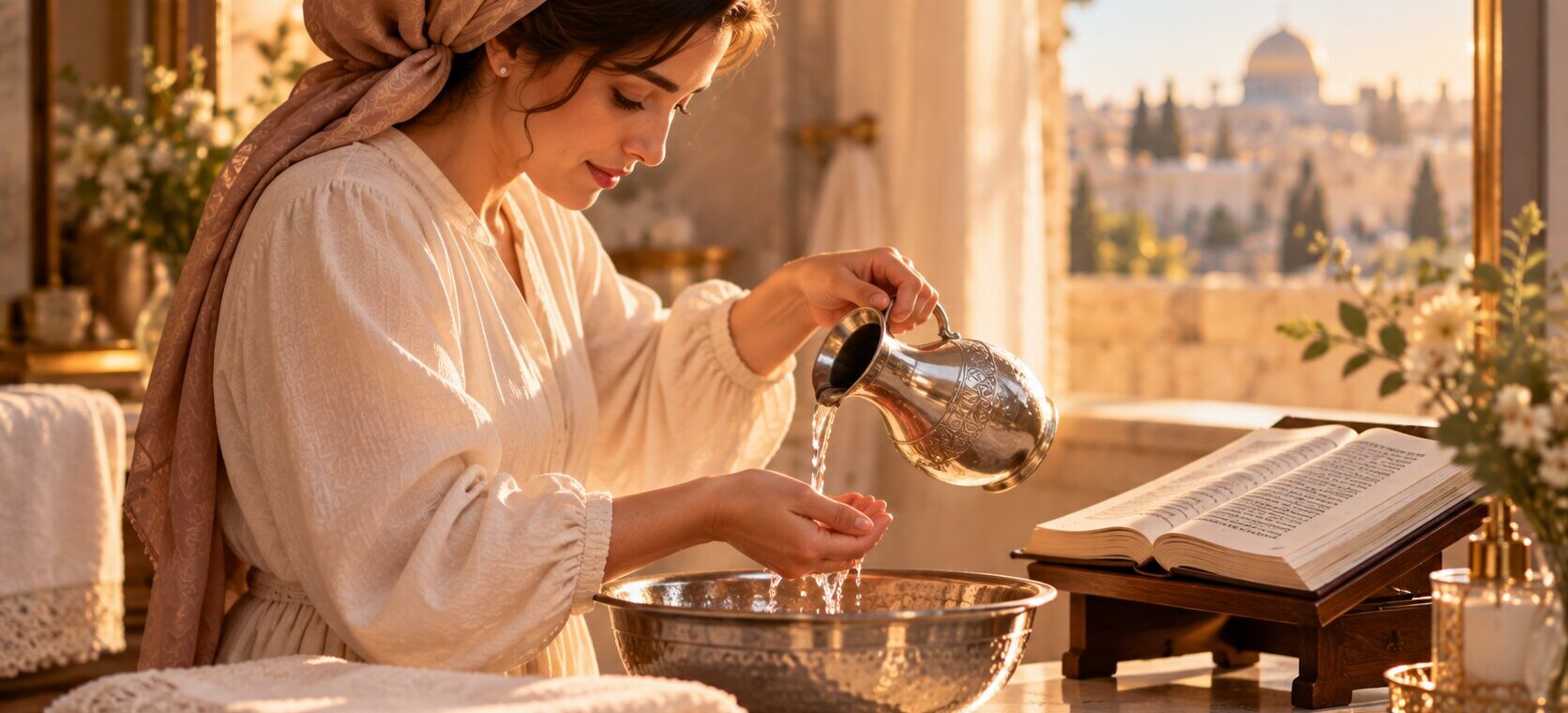
We take a vessel and pour water first on the right hand, then on the left. Then again on the right and the left. And once more — right and left.
In other words, each hand is washed three times, alternating between them.
Afterward, you dry your hands.
That's exactly why netilat yadayim isn't just about hygiene. We're not simply rinsing off whatever's left on our hands from sleep. It's a spiritual act, the one with which a Jew begins the day.
And we say the blessing:
"Asher kidshanu b'mitzvotav v'tzivanu al netilat yadayim" — "Who has sanctified us with His mitzvot and commanded us concerning the washing of hands."
Not Every Hand-Washing Is the Same
Here it's important not to mix up different things.
There's netilat yadayim, which we do in the morning after sleep.
There's washing hands before eating bread — that's a separate topic with its own laws.
And there's washing hands after using the bathroom. For that washing, we don't say the blessing "al netilat yadayim"; after the bathroom there's a separate blessing — "Asher Yatzar."
So when we talk about netilat yadayim here, we mean specifically the morning washing.
As Soon as Possible After Waking Up
It's best to do the morning netilat yadayim as quickly as possible.
Some people even keep a vessel of water ready by the bed, along with a basin to pour the water into.
But if you don't have that, try to get to the nearest place where you can properly wash your hands and do netilat yadayim.
What Can We Do Even Before That?
The very first thing we say when we wake up is our gratitude to Hashem:
"Modeh ani lefanecha…"
We thank Him for waking up, for returning our soul to us.
Since this phrase doesn't contain Hashem's Name, it can be said even before netilat yadayim.
It comes together beautifully: the very first thing a Jew does each day is give thanks. And the next step is purification and preparation for the new day.
What Shouldn't You Touch Before Netilat Yadayim?
Until a person has done the morning hand-washing, caution is needed.
You shouldn't touch your eyes, nose, mouth, or other openings of the body with your hands.
It's also important to try not to touch food before your hands have been washed.
When it comes to food that was touched before netilat yadayim, there are various details and opinions, including situations involving significant financial loss. So in practice, it's best to check with a rabbi.
But ideally, it's much simpler: wake up, and do netilat yadayim as soon as possible.
What About Young Children?
Parents often ask: what about the kids? At what age should they start doing netilat yadayim?
Here too, it's important to gradually get a child used to the morning hand-washing.
If it's a very small baby who's still nursing and doesn't yet pick up food on their own, you can be more lenient.
But once the child gets older and starts picking up food, cookies, fruit, and other things on their own, it's important to start getting them used to netilat yadayim.
And this, by the way, is another wonderful piece of Jewish upbringing.
From early childhood, the child gets used to this: the morning doesn't start with a phone, with breakfast, or even with everyday tasks. The morning starts with gratitude to Hashem and netilat yadayim.
But There's Another Reason
So far we've said that netilat yadayim is needed to remove ruach ra'ah.
But there's another explanation, one that reveals a completely different meaning behind this mitzvah.
When a person wakes up in the morning, a new day lies ahead.
They'll pray, work, take care of their children, cook, help others, earn a living, give tzedakah.
And all of that can also be service to Hashem.
Sometimes we think serving Hashem only happens when a person is in the synagogue, praying, putting on tefillin, keeping kashrut, or doing some specific mitzvah.
But that's not quite right.
If a person goes to work in order to honestly provide for their family — that, too, can be service to Hashem.
If a mother is raising her children — that is service to Hashem.
If we earn money so that we're able to give tzedakah — that too is part of our service.
For a Jew, one's whole life can become service to Hashem.
And that's why there's another explanation for the morning hand-washing: we are, in a sense, preparing ourselves for the service of the new day.
Just as the kohanim washed their hands before serving in the Temple, we wash our hands in the morning before starting our day.
And with that, netilat yadayim takes on an entirely different meaning.
We wake up, thank Hashem for the soul He's returned to us, wash our hands, and in a way we're saying:
"Hashem, You've given me another day. Now I want to live it the right way. Let everything I do today become part of my service to You."
And maybe that's exactly why such a simple act — pouring water over your hands a few times — becomes so meaningful.
Because netilat yadayim doesn't just mark the start of our morning. It marks the start of another day of our life alongside Hashem.




Comments