
Covering Her Hair: The Spiritual Essence and Kabbalistic Meaning of Kisui Rosh

More Than a Custom
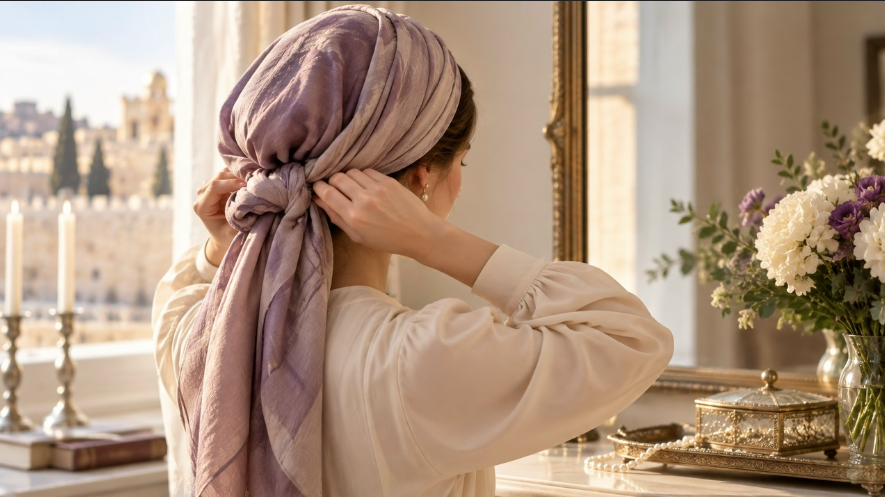
In Jewish tradition, a married woman's head covering (kisui rosh) is far more than a mere custom or a matter of modesty. It is a profound spiritual act, rooted in the Torah, the Talmud and kabbalistic teachings.
Let us step into the many-sided world of this special mitzvah, which is a true adornment of the Jewish woman.
Sources in Jewish Tradition
The primary source for the law of head covering is found in the Torah, in the passage about the sotah (a woman suspected of unfaithfulness).
In the book of Bamidbar (Numbers 5:18) it is written that the kohen "uncovers the woman's head." The Talmud (tractate Ketubot 72a) derives from this that married women's heads are normally meant to be covered.
The Rambam writes in the Mishneh Torah (Ishut 24:12): "The daughters of Israel should not go about in the marketplace with their heads uncovered — neither married nor unmarried."
And the Shulchan Aruch (Even HaEzer 21:2) establishes this as law: "Jewish women should not walk in the marketplace with their heads uncovered, whether married or unmarried."
In our day there is no requirement for unmarried women to cover their heads, and this rests not on a specific law but rather on interpretation and tradition. Neither the Torah nor the Talmud contains an explicit prohibition on unmarried women going with their heads uncovered.
Most rabbinic authorities interpret the existing sources as referring only to married women. In addition, a head covering is often seen as a sign of a woman's married status.
It is worth noting that some ultra-Orthodox communities may keep stricter practices, but on the whole, Jewish law contains no requirement for unmarried women to cover their heads.

The Kabbalistic Meaning of Covering the Hair
According to kabbalistic teaching, a woman's hair is a conduit of spiritual energy. Rabbi Shimon bar Yochai explains in the Zohar that hair is connected to the higher spiritual realms and to the channels of Divine abundance.
Rebbetzin Tzivia Eliyahu, a well-known Torah teacher, observes: "When a woman covers her head after her wedding, she is not hiding her beauty — she is guarding a special energy that is now accessible only within the space of intimate connection with her husband. Hair is the channel through which higher spiritual energy flows, and covering it creates a kind of vessel for that energy."
Rebbetzin Esther Jungreis writes in her book "Life as a Calling": "Covering the hair is not a limitation but an elevation. A woman becomes like a Torah scroll, which is wrapped in a beautiful mantle that highlights its holiness and significance."
According to Kabbalah, after her wedding a woman reaches a new spiritual level, receiving an additional soul — "or makif" (the surrounding light). Covering the head symbolizes the protection of this light and its direction inward, into the space of the home and the family.
It is interesting to note the different head coverings worn by women in various Jewish communities. Some women from Lithuanian and Chassidic communities wear wigs; others wear scarves, hats or berets. These differences reflect the richness of Jewish tradition and show that the outer form matters less than the spiritual content.
Rebbetzin Dina Freidman says: "It is not so important HOW a woman covers her head; what matters more is WHY she does it. When covering the head becomes a conscious act of connecting with her own spiritual essence, it transforms the whole woman."
Revealing Her True Nature
A Jewish woman's head covering is not merely a religious requirement or a custom. It is a profound spiritual act, reflecting an understanding of the special role of the woman in Jewish tradition. Through this outward symbol, a woman expresses her connection to her inner essence, to the Divine presence in the world.
As Rebbetzin Sarah Schenirer, founder of the Beit Yaakov school system for girls, said: "When a woman covers her head, she is not hiding herself from the world — she is revealing her true spiritual nature."
Comments