
Simchat Torah and Shemini Atzeret: The Final Note of the Autumn Holidays, the Joy of Closeness and the Joy of Torah

Stay With Me One More Day
The autumn cycle ends on a double chord: Shemini Atzeret and Simchat Torah. They come right after Sukkot and, as it were, draw a line under the "Days of Awe" and the joy of the sukkah. This is the time when the rainy season begins in the Land of Israel, and prayers for rain enter the daily prayers. But the main thing is that the tone changes: from a nationwide, "outward" joy to an intimate, "homelike" closeness with G-d and to the bright joy of the Torah itself.
The Sages explain the word "atzeret" as "holding back": after the seven days of Sukkot, the Almighty seems to say to Israel — "it is hard to part, stay one more day." If on Sukkot we brought 70 bulls "for the nations of the world," on Shemini Atzeret we bring one — like a family dinner after a great public celebration. On this day we no longer take up the four species and, in the Land of Israel, we no longer sit in the sukkah: the emphasis shifts from outward symbols to inner closeness. During the Musaf prayer the prayer for rain, Tefillat Geshem, is recited, and from this moment the words "He makes the wind blow and the rain fall" are added to the Amidah. In many communities the memorial prayer Yizkor is read — the memory of loved ones becomes part of the shared request for blessing in the year ahead.
Simchat Torah: An Instant New Beginning
Simchat Torah — "the joy of the Torah" — is the holiday on which the Jewish world completes the annual cycle of reading the Five Books and immediately begins again: we read "This is the blessing" and right after it "In the beginning." The meaning of this is as follows: the Torah has no end; love for it is not only study but also dance.
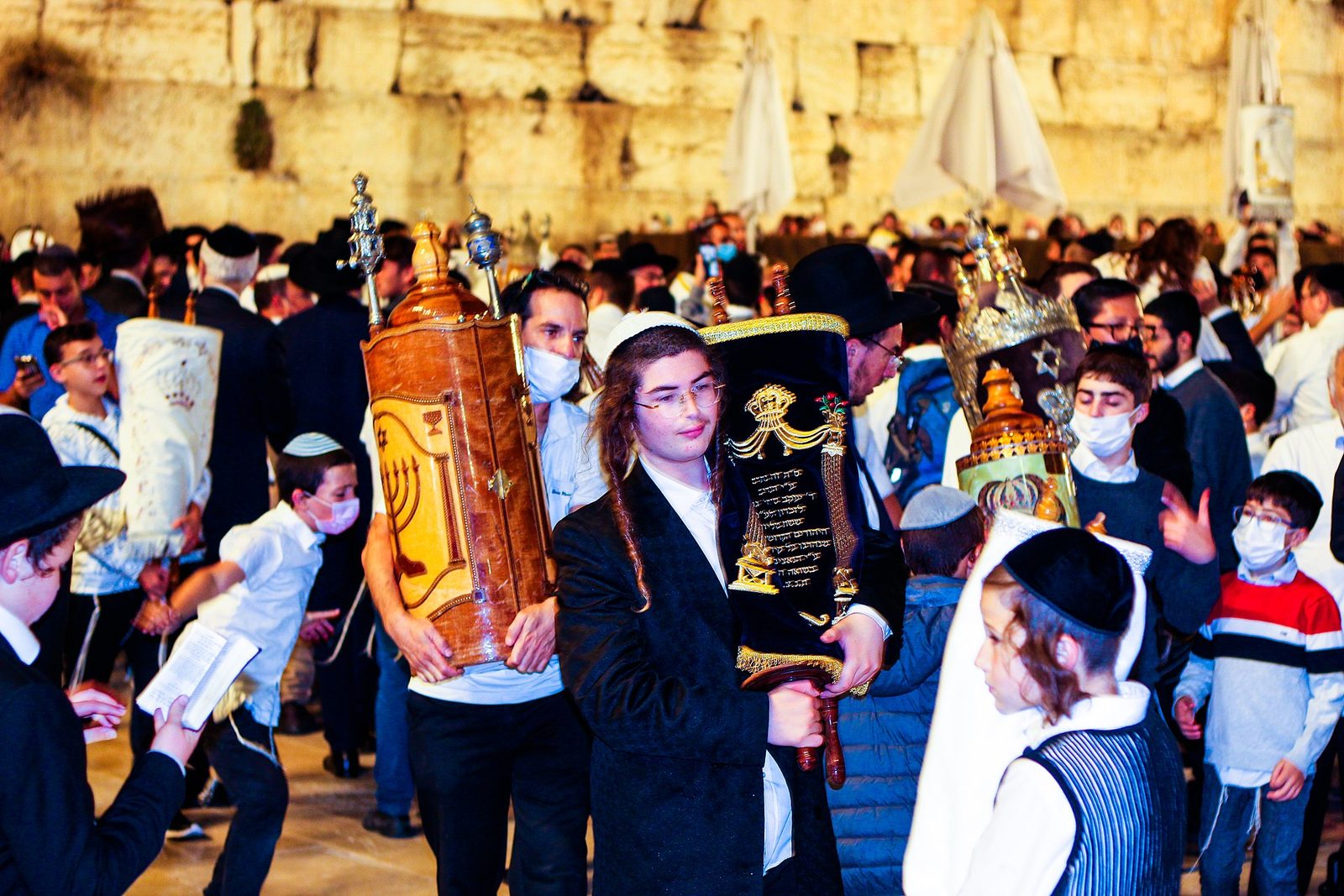
In the evening and in the morning the scrolls are taken out, circles — hakafot — are made with singing, and everyone tries to "press" the Torah to their heart. Readings of honor go to the Chatan Torah (the bridegroom of the Torah) — the one called up for the concluding reading — and to the Chatan Bereishit, who opens the new cycle.
The children are gathered under outstretched tallitot for a special aliyah, "Kol Hane'arim" — a sign that the Torah belongs to the next generation too.

One Day or Two?
Why one day in Israel and two days abroad? In the Land of Israel, to this day, every yom tov lasts one day (except Rosh Hashanah) — it has always been so, since the calendar was determined in Israel itself. Outside the Land of Israel, in ancient times the news of the start of the month did not always arrive on time, so a second, "additional" day of the holiday was introduced — yom tov sheni.
When the calendar became fixed, the Sages ruled that this custom should be kept. Hence the difference:
- In Israel, Shemini Atzeret and Simchat Torah merge into one day — the 22nd of Tishrei.
- In the Diaspora they are celebrated on two consecutive days: the first is Shemini Atzeret proper, the second is Simchat Torah.
A historical detail adds meaning: the very idea of "rejoicing in the Torah" as a separate holiday took shape in Babylonia together with the annual reading cycle; that is why, outside Israel, the second day was naturally set aside specifically for Simchat Torah, whereas in Israel both meanings live in a single day.
How It Is Celebrated
In Israel. In the evening, candles are lit with the blessing over the candles and "Shehecheyanu," and then the holiday immediately unfolds in dancing with the scrolls. Hakafot are held in the evening and in the morning. At the morning service the end of the Torah is read and "Bereishit" is begun, the "bridegroom of the Torah" and the "bridegroom of Bereishit" are blessed, and all the children are called up to the Torah. At Musaf the prayer for rain is recited, the kohanim bless the people, and those who remember their departed loved ones say Yizkor. The sukkah is already "closed": people eat and celebrate at home. After the holiday ends, many cities hold "hakafot shniyot" — a second round of dancing, with music and instruments, now on a weekday footing, to let the joy sound once more under the open sky.
Abroad. On the first day — Shemini Atzeret — the "Geshem" insertion is recited, rain begins to be mentioned in the Amidah, and Yizkor is read. By the custom of most communities, people eat in the sukkah out of respect for its "closeness" to Sukkot, but without the blessing "Leishev basukkah," and as a rule they do not sleep in the sukkah.
The second day — Simchat Torah — is given over entirely to dancing and reading: evening and morning hakafot, multiple aliyot to the Torah, "Kol Hane'arim," the Chatan/Kallat Torah and Bereishit, and the immediate new start. The atmosphere is noisy in a family way: sweets for the children, refreshments after prayers, long tables, songs, stories, blessings.
Traditions and Meaning
The main sign is the hakafot: seven circuits with the Torah, when the community literally "carries" joy around the hall. At home, a festive meal is prepared. Simcha — joy — is very tangible here: good wine, songs, the embraces of friends.
On Shemini Atzeret, the special prayer for rain coincides with the start of the agricultural year in Israel: we ask not only for spiritual light but for real water for life. In some places separate children's circle dances are held, with little flags and paper crowns — the Torah as the crown of the year.
If Yom Kippur is the culmination of truth, then Shemini Atzeret is the culmination of closeness: "stay a little longer," so that quiet may enter the home. Simchat Torah is the culmination of love: we rejoice not in "our own" wisdom but in a gift that is always greater than we are. Thus the autumn holidays close the circle: awe, joy, closeness, water, and — the circle of the Torah, which does not close but opens anew.
In Israel the two meanings live in one day, abroad in two neighboring ones, and everywhere it is about the same thing: to go on living the year with the sense that the Torah is alive and the connection is close. In the synagogues the prayer for rain, "Geshem," is heard; in the homes, laughter and songs; in the streets, circle dances. The final note of the holidays is like a breath before a long year: with rain in the fields and light in the books.
Comments